Exterior Composite Shutters vs. PVC Shutters
Written by ShutterLand, a U.S. exterior shutter specialist with over two decades of hands-on experience in shutter measurement, material selection, finish options, and installation for residential homes and commercial properties.
Composite shutters and PVC shutters are two durable alternatives to traditional wood exterior shutters, but they are best suited to different applications.
Composite shutters are generally the better value for stationary decorative installations, while PVC shutters are the better choice when shutters need to be functional, when individual open louvers are important, or when a Bahama shutter is desired. Both offer a substantial painted appearance and long-term exterior durability, but their construction, moisture resistance, installation options, and price are different.
Composite vs. PVC Shutters: Quick Comparison
| Composite Shutters | PVC Shutters | |
|---|---|---|
| Material | Extira engineered wood-fiber composite, no detail on back | Solid PVC profiles; some solid-panel styles use composite center panels |
| Installation | Fixed only | Fixed or functional |
| Louvers | Simulated louver sections with no open space | Individual louvers with open spacing |
| Bahama Style | No | Yes |
| Moisture | Highly moisture resistant; painted finish should be maintained | PVC components do not absorb moisture |
| Appearance | Closely resembles painted wood | Closely resembles painted wood |
| Weight | Heavy; varies by style and size | Heavy; varies by style and size |
| Price | Generally lower | Generally higher |
| Finish | Painted, primed-only, or unfinished | Painted, primed-only, or unfinished |
| Best Use | Stationary decorative shutters | Fixed, functional, historic-style, and Bahama shutters |
Both are high-quality solid exterior shutter materials. The best choice depends primarily on how the shutters will be installed and which style and construction details are important to the project.
What Are Composite and PVC Shutters?
Composite Shutters
ShutterLand composite shutters are manufactured from Extira, an engineered exterior material composed of approximately 90% wood fiber combined with phenolic resins, zinc borate wood preservative, and a water repellent. The material is pressed into dense solid panels that are cut, shaped, and assembled into exterior shutter components.
The result is a substantial shutter that closely approximates the appearance and proportions of wood shutters when finished. Composite shutters are specifically designed for installation in a stationary position beside the window.
PVC Shutters
PVC exterior shutters are constructed primarily from solid polymer profiles engineered for outdoor use. Multiple polymers are co-extruded to produce straight, consistent components with a smooth surface.
Construction varies somewhat by shutter style. PVC louvered shutters use individual PVC louvers, and board-and-batten shutters use individual PVC boards. Raised panel, flat panel, shaker, and some combination shutters incorporate an Extira composite center panel within surrounding PVC stiles and rails.
This construction allows PVC shutters to reproduce many characteristics of traditional wood shutters while also allowing most styles to be mounted with functional shutter hinges.
Construction and Moisture Resistance
Composite and PVC shutters are both engineered for long-term exterior use, but the materials handle moisture differently.
Extira composite is engineered to resist moisture, rot, termites, checking, splitting, and cracking. PVC does not absorb water and performs especially well in wet or humid environments. Both materials benefit from a properly maintained exterior finish, which protects the surface and preserves the appearance of the shutters. Any damaged or exposed areas should be repaired and refinished as needed.
Both composite and PVC offer excellent resistance to the moisture-related deterioration commonly associated with untreated natural wood.
Exterior Shutter Appearance
Composite and PVC shutters can both closely resemble traditional painted wood when viewed after installation. The differences become more noticeable when examining how individual shutter styles are constructed.
Raised panel, flat panel, and shaker shutters made from either material have similar proportions and architectural depth. PVC solid-panel shutters use PVC stiles and rails surrounding an Extira composite center panel, while composite shutters are constructed predominantly from Extira components.
Board-and-batten shutters differ more noticeably. Composite board-and-batten shutters are machined from a solid sheet with vertical grooves that create the appearance of separate boards. PVC board-and-batten shutters are assembled from actual individual vertical boards and can be configured with the boards together or with open spacing between them.
The smooth consistency of PVC generally produces very straight, uniform components. Composite is also smooth across its flat surfaces, although areas machined across the wood-fiber substrate—particularly angled louver surfaces—can have a slightly more textured appearance.
Composite vs. PVC Louvered Shutters
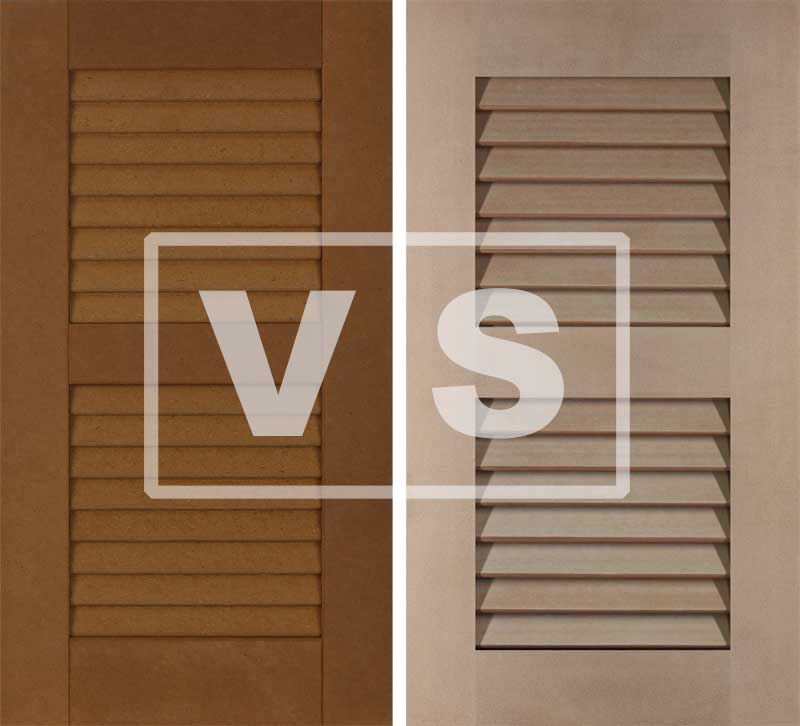
The most significant visual difference between the materials can be found in louvered shutters.
PVC louvered shutters are constructed with individual louvers separated by open space. This construction more closely follows traditional wood shutter construction and allows visibility and airflow between the louvers.
Composite louvered shutters are machined in sections of simulated louvers. The individual louver profiles are connected, with no open space between them. When installed beside a window, the angled profiles provide the appearance of traditional louvers without requiring individual slats.
Composite louvers work very well for stationary decorative shutters. However, PVC or wood louvered shutters may be a better choice for historic projects or other applications where individual louvers and open spacing are important.
Functional vs. Fixed Installation
Installation is one of the most important differences when comparing composite and PVC shutters.
Composite shutters are designed only for stationary installation. They have one primary presentable side and are not intended to swing open and closed over a window. Clear, V-shaped polycarbonate mounting brackets are included with composite shutters and attach to the top and bottom of the shutter. Additional smaller brackets are employed when necessary on larger shutters.
Learn more about installing composite exterior shutters.
PVC shutters can be installed either in a fixed position or with functional hardware. Polycarbonate mounting brackets are available when PVC shutters will remain permanently beside the window.
For functional installation, PVC shutters can be mounted with exterior shutter hinges. Because PVC shutters are relatively heavy, multiple hinges are generally required to properly distribute the weight. Functional shutters should also receive appropriate lower support when they are in the open position.
Learn more about installing PVC exterior shutters.
If the shutters need to swing closed over the window opening, PVC is the appropriate choice between these two materials.
Available Composite and PVC Shutter Styles
Composite and PVC shutters are both available in many of the most popular exterior shutter styles:
- Louvered
- Raised panel
- Flat panel
- Shaker panel
- Combination
- Board and batten
The major exception is the Bahama shutter. Bahama shutters require individual louvers with open spacing, making PVC suitable for this style while composite is not.
Both materials also offer extensive customization depending on the selected shutter style, including exact width and height, divider rail placement, louver configurations, top profiles, and paint colors.
PVC Bahama Shutters
Bahama shutters—sometimes called Bermuda shutters—attach along the top of the window and project outward from the bottom.
In the open position, the angled shutter helps shade the window while individual louvers allow airflow and partial visibility. PVC is particularly well suited to this configuration because it can be constructed with individual spaced louvers and its PVC components do not absorb moisture.
Composite shutters are not offered in the Bahama style because their interconnected louver sections do not provide the open spacing characteristic of a traditional Bahama shutter.
ShutterLand PVC Bahama shutters are architectural shutters and are not hurricane-impact shutters. Properties requiring approved storm protection should instead consider aluminum Bahama hurricane shutters specifically engineered and tested for that application.
Composite vs. PVC Shutter Price and Value
Composite shutters are generally the more economical of these two solid shutter materials. They provide a substantial appearance, custom sizing, strong weather resistance, and long-term durability at a price typically below PVC and premium wood shutters.
PVC shutters cost more, but the additional price provides construction options that composite cannot offer. PVC can be used for functional shutters, individual louver construction, open-weave board-and-batten shutters, and Bahama shutters.
For a stationary decorative installation, composite often provides the better value. When functional operation or a more traditional method of construction is required, the additional cost of PVC can be justified by its greater versatility.
Composite and PVC Shutter Colors and Finish
Composite and PVC shutters can both be ordered factory painted, primed only, or fully unfinished.
Factory-painted exterior shutters are prepared with General Finishes Enduro White Undercoat primer / sealer followed by two professionally sprayed coats of General Finishes Exterior 450 Topcoat. The factory finish is applied in a satin sheen across the faces, backs, edges, louvers, panels, and other exposed components.
ShutterLand offers nine standard exterior shutter colors or can match virtually any custom color by providing the paint manufacturer, color name, and color number.
Primed-only shutters receive the factory primer coat without finish paint and are ready for application of the final exterior paint color after delivery.
Fully unfinished shutters receive no primer or finish paint. Composite should be prepared and primed before painting. PVC surfaces should be cleaned, lightly scuff-sanded to promote adhesion, and primed with a compatible exterior-rated primer before the finish coats are applied.
Neither composite nor PVC shutters are intended to be stained.
Maintenance and Lifespan
Both composite and PVC shutters require relatively little routine maintenance, but the painted finish should still be inspected periodically.
Composite shutters are engineered for exterior durability and moisture resistance. As with other painted exterior products, occasional chips or scratches should be touched up as needed to maintain the appearance and protective finish.
PVC components do not absorb moisture and are not susceptible to rot or termite damage. PVC can, however, expand and contract as temperatures change. Proper installation, adequate support, and an intact flexible paint finish help accommodate normal movement, particularly with larger shutters.
Actual shutter lifespan depends on climate, exposure, installation, finish maintenance, and shutter configuration. Both composite and PVC are designed as durable, long-term exterior shutter materials, with PVC generally offering the advantage in moisture resistance and installation versatility.
Which Is Better: Composite or PVC Shutters?
There is no one universal best shutter construction material for all projects.
Choose composite shutters when:
- The shutters will remain permanently fixed beside the window.
- You want the substantial appearance of a solid custom shutter.
- Individual open louvers are not required.
- You want a lower-priced alternative to PVC or premium wood.
- A Bahama shutter is not needed.
Choose PVC shutters when:
- The shutters need to swing open and closed.
- Individual louvers with open spacing are important.
- A more historically traditional louver construction is preferred.
- You want PVC board-and-batten shutters made from individual boards.
- You need a Bahama shutter.
- Maximum resistance to moisture is a priority.
For many homes, composite is an excellent choice for attractive stationary shutters, while PVC is the more versatile material for functional and traditionally constructed shutters.
Explore all exterior shutters or use our exterior shutter material comparison to compare composite and PVC with wood, vinyl, and aluminum.
Current manufacturing and shipping estimates are available on the ShutterLand production and delivery page.