How to Measure For Exterior PVC Shutters
Measuring instructions are written by ShutterLand, a U.S. exterior shutter specialist with over two decades of hands-on experience sizing for residential homes and commercial properties.
The correct measurements for PVC exterior shutters depend on how the shutters will be installed. Fixed PVC shutters are permanently mounted beside the window and are primarily sized for appearance and proportion. Functional PVC shutters are installed with hinges and must be sized to cover the window opening when closed.
Determine the installation method before taking final measurements. Functional shutters require greater precision because shutter dimensions, window depth, hinge location, mounting surface, and operating clearance all work together.
Every ShutterLand PVC shutter is made to order using the dimensions and available options selected for the individual product. Additional information about PVC construction, styles, finishes, and available configurations is available on the Exterior PVC Shutters page.
A steel tape measure, pencil, paper, and sturdy ladder are generally all that is needed. Measure every window individually rather than assuming similar-looking openings are identical.
Decide Between Fixed and Functional PVC Shutters
Before measuring, determine whether the shutters will remain stationary or operate with hinges.
Functional PVC Shutters
Functional PVC shutters are installed on both sides of the window and swing open and closed. When closed, the pair should cover the window opening while maintaining enough clearance around the perimeter and between the shutters to operate freely.
Functional shutters can close within a recessed window opening or in front of the window and casing.
Hinge selection should be considered during the measuring process. Window depth, shutter thickness, mounting surface, hinge and pintle offset, and the intended closed position all influence the final shutter dimensions.
Review the available exterior shutter hinges before finalizing measurements.
Fixed PVC Shutters
Fixed PVC shutters are permanently installed beside the window and do not need to close over the opening. Their dimensions are therefore more flexible.
For an authentic appearance, fixed shutters are generally proportioned to resemble shutters that could cover the window if closed.
PVC shutters installed in a fixed position use mounting brackets to support the shutter beside the window. Review the PVC Exterior Shutter Installation Guide for fixed-mount hardware and bracket placement.
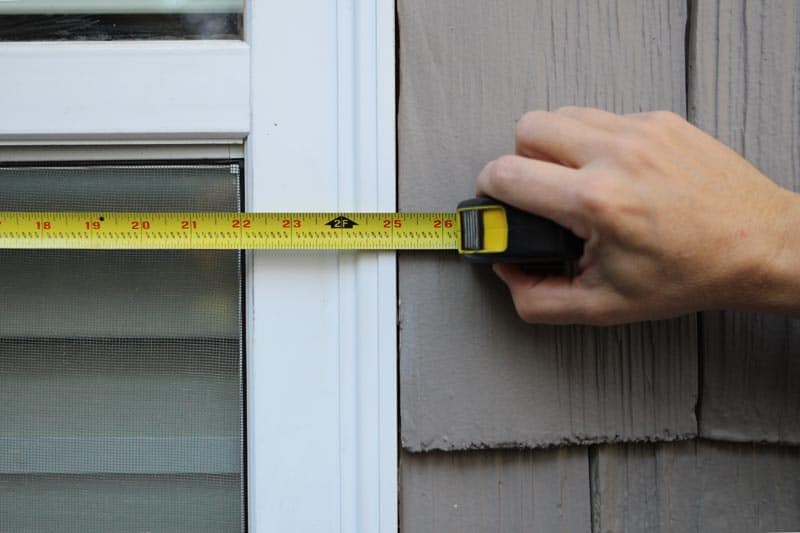
Inspect the Window and Surrounding Area
Before recording final shutter dimensions, inspect the window and surrounding wall.
Check for:
- Window casing and trim
- Projecting window sills
- Siding
- Brick or stone
- Downspouts
- Building corners
- Adjacent windows
- Light fixtures
- Other projections or obstructions
Functional shutters need enough unobstructed space to swing from the closed position and rest beside the window when fully open.
Also identify where the hinge hardware will attach. The available mounting surface can affect pintle style, hinge offset, and final shutter position.
How to Measure for Functional PVC Shutters
Functional PVC shutters require accurate measurements so the panels can cover the opening when closed and swing freely when operated.
Step 1: Determine the Closed Shutter Position
First determine whether the shutters will close within the window opening or in front of it.
Inside-Mount Functional Shutters
An inside-mount installation positions the closed shutters within the recessed window opening.
Measure the usable depth of the opening and account for the thickness of the selected shutter, hinge system, and any window components or other obstructions.
There is not one minimum recess depth that applies to every installation. The required depth depends on the shutter and hardware configuration.
Outside-Mount Functional Shutters
When the shutters cannot close within the opening, they can be positioned in front of the window or casing.
Establish the intended closed position before determining the final shutter dimensions. The selected hinge and pintle offsets must provide enough throw for the shutter to move between the closed position and its resting position beside the window while clearing trim, siding, masonry, or other projections.
Step 2: Measure the Shutter Width
Inside-Mount Functional Shutters
Measure the clear width of the window opening at three locations; top, middle, and bottom. Record the smallest measurement.
Allow approximately 1/8 to 1/4 inch of operating clearance where a moving shutter edge meets the opening or the adjoining shutter.
For two equal shutters:
Individual shutter width = (smallest opening width − total required horizontal clearance) ÷ 2
If a single shutter will cover the entire opening, do not divide the measurement by two.
Outside-Mount Functional Shutters
Establish the intended left and right outside edges of the closed shutters.
Measure between these two points.
For a pair of equal shutters, allow the required operating gap where the shutters meet in the center, then divide the remaining width by two.
Window casing, hinge offset, mounting location, and the intended closed position can all influence the final shutter width.
Step 3: Measure the Shutter Height
Inside-Mount Functional Shutters
Measure the opening height at three locations; left, center, and right. Use the smallest measurement.
Allow approximately 1/8 to 1/4 inch of operating clearance at the top and bottom.
Shutter height = smallest opening height − total required vertical clearance
Check for a sloped or projecting sill that could interfere with the shutter as it swings.
Outside-Mount Functional Shutters
Mark the intended top and bottom edges of the closed shutter and measure between these points.
Confirm that the shutter will completely cover the window opening and that the bottom edge can clear the sill throughout its swing.
The final position may be influenced by the window casing, sill, hinge location, and surrounding trim.
Step 4: Determine Divider Rail Location
A divider rail separates the shutter into upper and lower sections and can also provide a convenient location for intermediate functional hardware.
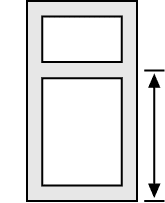
For a custom divider rail location, measure from the bottom of the finished shutter to the desired center of the divider rail.
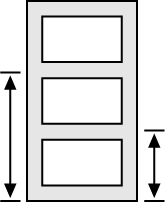
When two divider rails are selected, measure from the bottom of the shutter to the desired center of each rail.
On louvered shutters, the final divider rail position may shift slightly from the requested measurement so the rail works correctly with the number and spacing of the louvers. The requested measurement establishes the intended location.
More information about placement and configuration is available in the exterior shutter divider rail guide.
Step 5: Plan the Functional Shutter Hardware
PVC shutters are substantial and require multiple points of support when installed to operate. Hinge and lower-support locations should be considered while measurements are being taken.
| Shutter Height | Minimum Functional Support |
|---|---|
| Under 84 inches | Top hinge + bottom hinge + 1 intermediate hinge + 1 lower support |
| 84 inches or taller | Top hinge + bottom hinge + 2 intermediate hinges + 1 lower support |
PVC shutters under 84 inches therefore require a minimum of four points of support with the building. Shutters 84 inches or taller require a minimum of five.
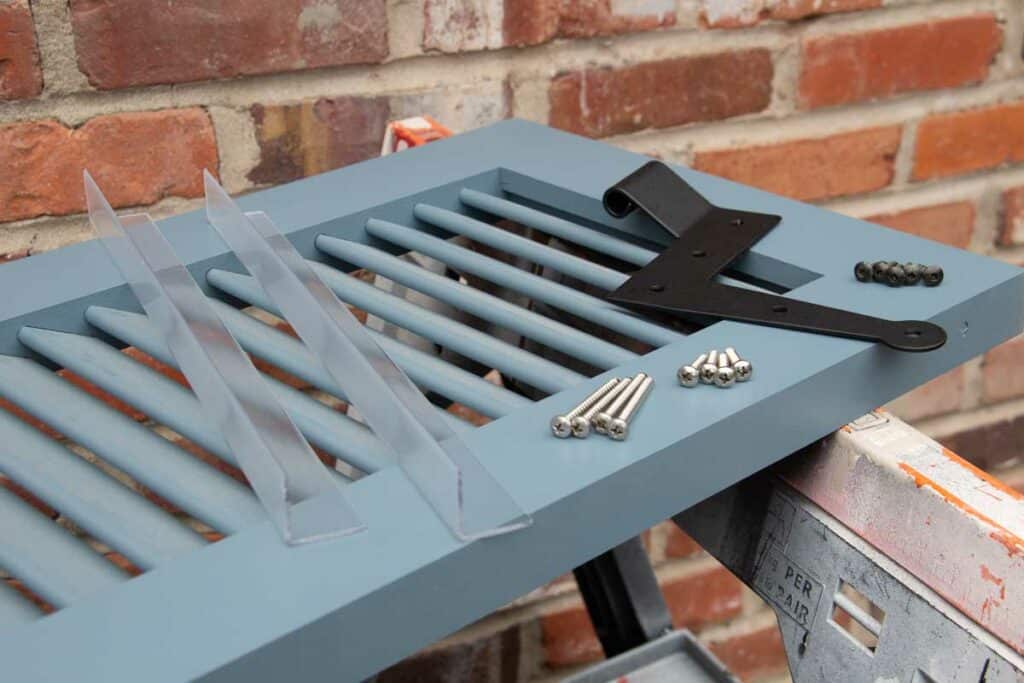
The lower support must make contact with and help carry the weight of the shutter when fully open. The lower support can be a separate component or a combined shutter dog support. When a standard shutter dog is used only to hold the shutter in the open position, an independent lower support is also required.
When surface-mounted strap or L-style hinges are used, the upper and lower hinges generally align with the corresponding shutter rails. Intermediate hinges often align with a divider rail or the center of the shutter.
The Exterior Shutter Hinge Guide and Shutter Dog Guide provide additional information for selecting functional hardware.
Allow for Normal PVC Movement
PVC naturally expands and contracts as temperatures change and becomes more flexible as temperatures rise.
Proper operating clearance and adequate support allow functional shutters to accommodate normal material movement. Shutters should not be measured to fit tightly against the top, bottom, sides, or adjoining shutter.
The complete PVC exterior shutter installation instructions provide additional guidance about hinge placement, support, clearances, and mounting.
How to Measure for Fixed PVC Shutters
Fixed PVC shutters do not require the precise operating clearances needed for functional shutters, but good proportions remain important.
Step 1: Measure the Shutter Width
Start with approximately half the window opening width for each shutter.
For example, a 36-inch-wide window opening would traditionally correspond with shutters approximately 18 inches wide when sufficient wall space is available.
Then confirm that the proposed width fits comfortably beside the window without crowding adjacent shutters, building corners, downspouts, lighting, or other exterior features.
For especially wide or grouped windows, narrower shutters may create better proportions. There is no single width ratio that works for every window configuration.
A cardboard template held beside the window can help evaluate different shutter widths before ordering.
Step 2: Measure the Shutter Height
For a traditional appearance, fixed shutters generally align with the top and bottom of the window opening.
When a projecting sill, surrounding trim, or another architectural feature provides a better visual reference, the shutter can instead align with those points.
Use the same approach consistently across similar windows on the same elevation.
Step 3: Determine Divider Rail Location
For a custom divider rail, measure from the bottom of the finished shutter to the desired center of the rail.
On double-hung windows, the divider rail is often positioned near the meeting rail of the window to create a visual relationship between the shutter and window.
When two divider rails are selected, record the desired center location of each rail as measured from the bottom of the shutter.
On louvered shutters and combination shutters containing louvers, the final divider rail position may shift slightly to accommodate louver spacing.
How to Measure for Arch-Top PVC Shutters
PVC shutters can be made with an arched top to complement round-top and other curved windows.
Arch-top shutters require the overall shutter width and height along with additional measurements that establish the shape and orientation of the arch.
Review the Arch-Top Exterior Shutter Guide before ordering an arched configuration.
Measuring for PVC Bahama Shutters
PVC Bahama shutters use a different measuring method from side-hinged Colonial shutters.
A Bahama shutter mounts horizontally above the window with a continuous top hinge and projects outward from the bottom with support arms.
Measurements need to account for the window dimensions, top-hinge mounting location, desired coverage, shutter projection, and support-arm placement.
Use the dedicated Bahama Shutter Measuring Guide when ordering PVC Bahama shutters.
PVC Shutter Measuring Tips
- Use a steel tape measure for accurate dimensions.
- Measure every window individually.
- Measure functional openings at three locations and use the smallest applicable dimension.
- Record the finished width and height of each individual shutter.
- Measure usable window depth for functional inside-mount shutters.
- Identify the available hinge mounting surface while measuring.
- Check for trim, masonry, sills, downspouts, light fixtures, corners, and other obstructions.
- Consider hinge and pintle offset before establishing final functional shutter dimensions.
- Record custom divider rail locations when applicable.
- Use an assistant when measuring large or elevated windows.
- Double-check all measurements before ordering.
Frequently Asked Questions About Measuring PVC Shutters
How wide should PVC exterior shutters be?
For fixed exterior shutters, approximately one-half of the window opening width for each shutter is a useful starting point for traditional proportions. Available wall space and the proportions of the window may require a narrower shutter.
Functional shutters require more precise sizing because the shutters must cover the opening when closed while maintaining enough clearance to operate.
How much clearance do functional PVC shutters need?
Approximately 1/8 to 1/4 inch of operating clearance is generally appropriate where moving shutter edges meet surrounding surfaces or another shutter.
How many hinges do functional PVC shutters need?
PVC shutters under 84 inches tall require at least a top hinge, bottom hinge, and one intermediate hinge.
PVC shutters 84 inches or greater in height require a top hinge, bottom hinge, and two intermediate hinges.
Every functional PVC shutter also requires a lower support that makes contact with and helps carry the shutter when it is open.
Can PVC shutters use butt hinges?
Yes. Conventional butt hinges can be used in some inset PVC shutter installations when the opening provides sufficient depth and the surrounding structure provides an appropriate mounting surface.
The hinge arrangement must still provide the required number of support points. Additional information is available in the Exterior Shutter Hinge Guide.
Can PVC shutters be permanently mounted beside a window?
Yes. PVC shutters can be installed in a fixed position with the appropriate mounting brackets when functional operation is not required.
Do PVC shutters expand and contract?
Yes. PVC naturally expands and contracts as temperatures change. Proper operating clearance and adequate support help accommodate normal material movement.
Check the Measurements Before Ordering
Before placing an order, confirm:
- Fixed or functional installation
- Inside-mount or outside-mount position for functional shutters
- Finished width and height of each individual shutter
- Required operating clearances
- Hinge and pintle configuration
- Required intermediate hinges and lower support
- Divider rail location, if applicable
- Arch-top configuration, if applicable
- Total number of individual shutters required
Enter the finished shutter dimensions in the order form.
Order Made-to-Order PVC Exterior Shutters
ShutterLand PVC Exterior Shutters are made to order using the dimensions and available specifications selected for each project.
After the measurements and hardware requirements have been established, select the appropriate shutter style and enter the finished dimensions on the product page.
Review the PVC Exterior Shutter Installation Instructions before installation begins.